The World Spirits Alliance and its members firmly support a “whole-of-society” approach to reducing the harmful use of alcohol.
This approach, backed by the United Nations and the World Health Organization (as per its Global Alcohol Action Plan 2022-2030), has been successful in reducing harms over many years.
Looking ahead, the WSA and its members are committed to working with governments, public health bodies, retailers, platforms and civil society to scale what works.

Enjoyment and responsibility go together. Across the world, WSA members support youth education programmes and server training initiatives, invest in consumer information campaigns focused on responsible drinking and partner with organisations such as law enforcement to tackle drink-driving, underage consumption and other harms.
‘Standard drinks’ or units of alcohol are a practical tool for understanding alcohol consumption and its effects. Many countries issue low-risk drinking guidance based on such units (usually expressed in grams or ml of pure alcohol).
Whether it comes from beer, wine or spirits, ethanol has the same effect on the body. We need to measure what matters:
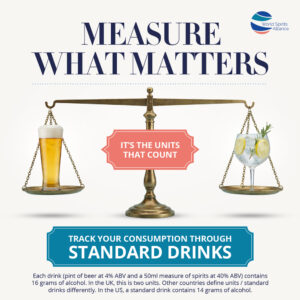
No scientific basis exists for differentiating between product types in alcohol policies like taxation and such differentiation could lead people to erroneously conclude that one type of alcohol beverage is inherently better from a health perspective or “more moderate” than another.
1: “Alcohol Units.” NHS. Accessed November 19, 2025. https://www.nhs.uk/live-well/alcohol-advice/calculating-alcohol-units/.
When consumed in moderation, alcohol beverages can be part of a balanced lifestyle, though not everyone should drink. Moderation means staying within national guidance and avoiding heavy episodic drinking (which the WHO defines as consuming 60g or more of ethanol on one occasion).
Policies designed around clear communication on units of alcohol and standard drinks can empower people to adopt better drinking habits.
Spirits offer flexibility and versatility for consumers seeking moderation. Cocktail recipes can be tailored by using less alcohol or by adding low-calorie mixers.
WSA and its members are unequivocally opposed to underage drinking. We support strong enforcement of legal purchase age rules across physical and digital channels and sanctions for violations. We are in favour of robust standards and practices that prevent alcohol sales and advertising to minors. We also partner on ID-checking, retail compliance and age-gating online.
We stand for:
WSA supports strong public guidance for situations carrying heightened risk and calls for extra caution.
Remember that laws and medical advice vary by country, so where there is doubt, we always recommend consulting and following local guidance.

“The distilled spirits industry is stronger when it speaks with one voice, and the Scotch Whisky Association is a proud partner of the World Spirits Alliance to help make that voice louder. To do this, and to safeguard the future of the sector, the WSA works with members to ensure spirits can be traded on a level playing field, tackling discrimination, promoting moderation, and showcasing sustainability”
“ISWAI is collaborating closely with WSA to establish a unified platform for the Alcobev industry, championing balanced policies, best practices, and responsible alcohol consumption. Together, we aim to transform the industry through premiumization, compliance, and enhanced ease of doing business, fostering a positive reputation and a harmonized policy framework.”
“The World Spirits Alliance (WSA) has proven to be a valuable asset to the Mexican Chamber of the Tequila Industry. Through the WSA, we gain access to a vast network of expertise and collective intelligence, enabling us to develop and implement effective strategies for the global promotion and protection of tequila and its appellation of origin.”
“Distilled spirits are a vibrant and highly dynamic sector with a unique diversity of products and producers across the world. With the World Spirits Alliance, we have a platform to speak with a single global voice on trade and social responsibility, key issues for our industry.”
“At Moët Hennessy, we deeply value the opportunity to build a strong reputation for our industry: the World Spirits Alliance ensures our voices are heard and it allows us to work collectively on key issues alongside our stakeholders. The WSA provides a vital platform for global advocacy, enabling us to address critical matters such as trade barriers and taxation.”
“We work closely with the World Spirits Alliance to continue to position the distilled spirits industry as responsible producers, creating economic benefits to New Zealand and contributing to the continued growth in responsible consumption.”